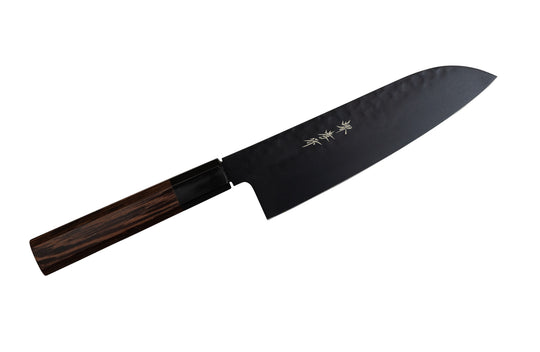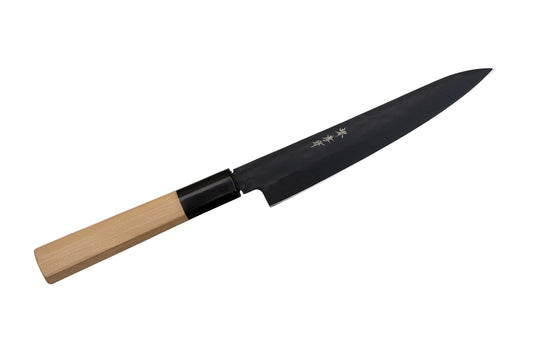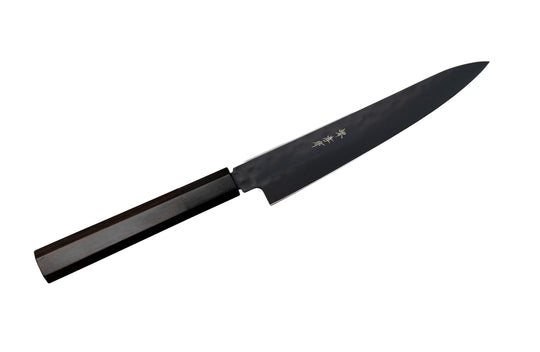


Sakai Takayuki Kurokage Gyuto 210mm — Wenge Octagonal Handle Sakai Takayuki
Handle wood
Steel
VG-10 high-carbon stainless (hammered, black fluorine coating)
Ferrule
Buffalo horn
Handle
Wenge, natural wood (octagonal)
Blade length
210 mm
Made in
Sakai, Osaka, Japan
Lightness
Sharpness
Ease of sharpening
Rust resistance
About Blade

The blade is made of VG-10, a high-carbon stainless steel developed by Takefu Special Steel and one of Japan's benchmark knife steels. Hardened to HRC 60–62 — close to carbon steel — it holds a keen edge for a long time, combining the rust resistance of stainless with the sharpness of carbon steel.
The blade face is hand-hammered (tsuchime) by the craftsman one strike at a time, then finished with a black fluorine coating, so wet or sticky ingredients release cleanly as you cut. The double-bevel edge suits right- and left-handed cooks alike.
About Handle

The handle is wenge, a prized Central African hardwood with a striking striped figure over deep chocolate brown. With a density of around 0.9, it is hard and highly durable.
Its calm tone suits both modern and traditional kitchens. The octagonal handle resists slipping and settles comfortably in the hand, and a buffalo horn ferrule protects the joint between blade and handle.
Producing Area
This knife is made in Sakai, Osaka — home of Sakai forged cutlery (Sakai Uchihamono), designated a Traditional Craft of Japan by the Minister of Economy, Trade and Industry.
In Sakai, forging, sharpening and handle-fitting are each carried out by dedicated specialist craftsmen — a division of labor handed down for some 600 years — and every knife is finished by hand to the highest standard of sharpness.
堺 Sakai, Osaka

 ©Sakai City, JAPAN
Sakai is a commuter town located in the Southern area of Osaka, and is the second most populous city in the prefecture after Osaka City.
Sakai is known for having many ancient burial mounds. Once, blacksmiths gathered and lived in Sakai from all over Japan to create tools for the construction of the mounds. This is believed to be the reason why Sakai is famous for forging.
In the Edo period, the shogunate's order included exclusive production of "Tobacco knives" in Sakai - knives for chopping tobacco leaves, which led to Sakai's fame for bladesmithing. As time went by, the technique has continued to be inherited by craftsmen over countless generations. To date, Sakai has been producing stunningly sharp knives with the best quality.
The production of forged knives in Sakai is based on the division of labor within each district.
To complete a single knife, each step, from forging and adding a blade, to attaching a handle, is handled by traditional specialists. It is expected to include more than 30 processes of knife creation until completion.
The significance of Sakai knives lies in the excellent forging and sharpening techniques which determine the edge of the blade.
Knives from Sakai are said to be used by over 90% of professional chefs of Japanese cuisine. Sakai is the leader of the world-class culture of Japanese bladesmithing.
Precautions For Use
To prevent rust
- Use dish soap to thoroughly wash the knife, and immediately wipe moisture away with a dry cloth before storage.
To prevent damage
- Do not ever put the knife in the dishwasher.
- Do not hold the knife over a fire or put in the oven. To disinfect the knife, please use hot water.
To prevent chips
- Do not use the knife on a hard surface, such as on a metal, stone, or glass cutting board.
- Do not cut hard objects, including frozen food and bone-in meat.
- Avoid putting multiple knives in the same drawer, as they may touch each other and chip.
For safety
- Handle the blade with care.
- Store the knives in a safe place and out of reach of children at all times.